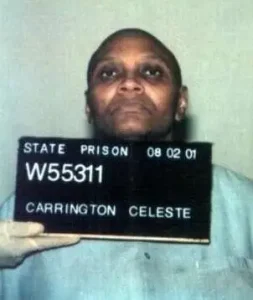
Lisa Carpenter Graham is a woman from Alabama who was sentenced to death for arranging the murder of her adult daughter.
Lisa Carpenter Graham would convince a friend, Kenneth Walton, to murder her adult daughter. Kenneth Walton would take Stephanie Shea Graham out on a drive and would eventually pullover. When he did so Kenneth Walton would fatally shoot Stephanie Shea Graham.
Soon the murder plot was discovered by police and Lisa Carpenter Graham and Kenneth Walton would be arrested and charged with the murder. Kenneth Walton would take a plea and be sentenced to life in prison.
Lisa Carpenter Graham decided to go to trial and in the end she would be convicted and sentenced to death.
Lisa Carpenter Graham Now

| Institution: | TUTWILER DEATH ROW |
Lisa Carpenter Graham FAQ
Where is Lisa Carpenter Graham now
Lisa Carpenter Graham Sentenced To Death
Convicted of capital murder for persuading a family friend to gun her daughter down on a remote dirt road in Russell County on July 5, 2007, Lisa Carpenter Graham was sentenced to death Wednesday.
Judge Jacob Walker III imposed that sentence after hearing testimony from psychologist and attorney Glen King, who was hired to conduct a presentencing psychological evaluation on Lisa Carpenter Graham, and from psychiatrist Heather Rowe of East Alabama Mental Health, who said she has been treating Graham since February 2013.
The evaluation was to determine whether Graham had any mental illness or other condition that would make her ineligible for the death penalty.
King testified his evaluation showed Graham is not mentally deficient and has no defect that would keep her from understanding the consequences of her actions. He added, though, that his tests showed Graham had an IQ of 77, indicating she likely would not in advance think through her actions like someone who scored higher.
He said his evaluation revealed Lisa Carpenter Graham scored low in “leisure and social activities,” meaning game-playing, travel and establishing friendships beyond immediate family. In that regard, she was “well below average,” King said.
When Russell County District Attorney Ken Davis asked whether Graham had been “malingering” or faking symptoms, King replied that he did not believe Graham tried to fake test responses. But he thought she had exaggerated her mental issues, embellishing psychiatric symptoms.
Also under Davis’ questioning, King acknowledged Graham was functional, having kept accounts balanced for her family business, having been literate and computer literate, and having pursued genealogical research as a hobby.
Rowe testified she found Lisa Carpenter Graham suffered from recurring and severe depression and had “borderline personality disorder.” She did not elaborate on the latter.
Online, the National Institute of Mental Health posts that borderline personality disorder is “a serious mental illness marked by unstable moods, behavior, and relationships,” and involves “problems with regulating emotions and thoughts; impulsive and reckless behavior; unstable relationships with other people.”
As testimony concluded, Davis argued nothing precluded Walker’s giving Lisa Carpenter Graham the death penalty.
Graham’s lead attorney Margaret Young Brown countered that King’s evaluation showed Graham had “borderline intellectual functioning” that casts doubt on her capacity to take reasonable actions.
She also called Walker’s attention to previous testimony by Graham’s son Kevin “Boo” Graham Jr., who told the judge that since his sister’s death, the only immediate family he has left are his mother, father and grandmother.
His mother’s execution would leave only the father and grandmother: “It wouldn’t be long for the rest of them to be gone, and then I’d have nobody,” he said.
A jury convicted Lisa Carpenter Graham March 5, and Walker III initially set a sentencing date of May 1, but then postponed it so Graham could be evaluated. Walker noted then that Graham had been diagnosed with post-traumatic stress disorder and was taking medications prescribed for schizophrenia.
Wednesday’s sentencing is not the end of the story, as Graham already has asked for a new trial and will appeal to the Alabama Court of Criminal Appeals. That process will add new chapters to what even veterans of the criminal justice system found to be a sordid and surreal story of a mother whose jealousy and disdain for her daughter led to a cold-blooded murder late at night on Bowden Road near Pittsview.
Lisa Carpenter Graham was convicted of persuading longtime family worker Kenneth Walton to kill her 20-year-old daughter Stephanie Shea Graham, who went by Shea. Walton said the mother met him at the Columbus Public Library on the evening of July 7, 2007, and loaned him her pistol for the job.
He later caught up with Shea at a Victory Drive gas station, where she left her car with friends and rode off in Walton’s pickup truck. He took her on a long, night drive down Alabama Highway 165 before pulling off on Bowden Road so they could relieve themselves.
When she got out to squat beside the truck’s open passenger door, he pulled out the pistol and shot her in the head from the driver’s seat, then got out, walked around the truck and shot her again and again.
He left her half-nude, bullet-riddled body where it lay, and drove away. Asked in court how his deadly betrayal of a young woman who trusted him made him feel, he replied, “I felt normal.”
Because witnesses saw Shea leave the gas station with Walton, investigators focused on him immediately. He confessed, and told them of the mother’s involvement, particularly of the pistol he had returned to her the day after the shooting.
Lisa Carpenter Graham then incriminated herself when authorities came looking for the gun. She had given it to an elderly neighbor she knew as “Papa” to clean, but told sheriff’s investigators she didn’t know where it was, and allowed them futilely to search her house before her husband told them “Papa” might have it.
Finding ample evidence of her involvement, investigators charged her with murder, and Davis announced he would seek the death penalty.
But five years passed before the case finally came to trial — the first time. Davis said Wednesday that the first delay resulted from courthouse renovation that made the building unsafe for holding a death-penalty trial.
Walton pleaded guilty June 14, 2012, and was sentenced to life in prison. Graham’s trial was set for the following fall.
But after jury selection and some initial testimony, then-Circuit Judge George Greene abruptly declared a mistrial on Sept. 25, 2012, saying he could no longer preside because of his failing health.
When prosecutors pursued a second trial, Graham’s defense team appealed, claiming Greene could have continued the trial, and to try Graham again would constitute double-jeopardy. During testimony in that appeal, witnesses said Greene had multiple health issues, and had been falling asleep in court, even snoring.
Greene retired in December 2013, and died Jan. 1, 2014.
After the Alabama Court of Appeals rejected the defense double-jeopardy arguments on Oct. 17, 2013, Graham’s attorneys appealed to the Alabama Supreme Court. It turned them down on Aug. 8, 2014.
Meanwhile other Russell County judges recused themselves from presiding at Graham’s next trial. Walker, a Lee County Circuit Court judge, was appointed to fill in.
Jury selection in the second trial began Feb. 17, with witness testimony starting the following week.
That testimony showed Lisa Carpenter Graham repeatedly had remarked to witnesses that Shea was ruining her life, and she would kill her daughter if she could. The daughter was facing aggravated assault charges related to a drive-by shooting in Columbus, and Graham feared she would flee town and leave her parents responsible for her $100,000 bond.
Walton testified he lured Shea into his pickup the night she died with the promise of providing her a vehicle in which to run away.
Graham’s attorneys would not comment after Wednesday’s sentencing, but Davis did.
“This is a case in which the death penalty was called for,” the prosecutor said, adding, “This was a woman who opportuned, cajoled, threatened another individual over the course of months to murder her biological child, to take her down into the darkness of Russell County, Alabama, on a dirt road and shoot her five times.”
With Graham’s appeals pending, much work remains to be done, he said.
“This is really the beginning of a capital case,” Davis said. “A capital case calls for automatic appeals. Those appeals will go up on both levels, both the federal level and the state level. No one can say what will happen on appeal. It’s a process the attorney general of Alabama will be involved in, and we will certainly be current with it.”
https://www.ledger-enquirer.com/news/local/crime/article45356997.html
Lisa Carpenter Graham News
Lisa Leane Graham was convicted of hiring Kenneth Walton to murder her daughter, Stephanie “Shea” Graham, for “a pecuniary or other valuable consideration or pursuant to a contract or for hire,” a murder defined as capital by § 13A-5-40(a)(7),Ala. Code 1975.Graham’s first trial ended in a mistrial, and she was tried a second time and convicted of capital murder.
The State’s evidence tended to show that on July 5, 2007, Earlic Dinkins was driving on Highway 165 near Bowden Road when he discovered the partially nude body of Shea Graham lying on the side of the road.Dinkins telephoned emergency 911, and shortly thereafter Russell County sheriff’s deputies arrived on the scene.Dr. Steven Boudreau, a pathologist with the Alabama Department of Forensic Sciences, testified that Shea died of multiple gunshot wounds.Dr. Boudreau testified:
"There was a close range gunshot wound which had entered the right eye and obliterated the right eye and orbit.The bullet went through the head and exited the back of the head.There was another gunshot wound to the head at the back right side of the head which entered the skull and exited over on the left side of the head.There was, in addition, a gunshot wound in the chest ... and exited the back.It perforated -– the lung and the top part of the liver on its way through.There were two gunshot wounds in the abdomen.One in the upper right abdomen, which lacerated the liver again and then exited the back.The second gunshot wound to the abdomen ... just went through the skin on the right-hand side."(R. 3075.)Both shots to Shea’s head were fatal wounds, Dr. Boudreau said.(R. 3078.)
Kevin Graham, Graham’s husband, testified that when he learned of Shea’s death he informed police that Kenneth Walton was probably responsible because, he said, Walton had told him on two occasions that Graham had asked Walton to kill Shea.1Kevin also testified that he had given Graham a gun and that she kept that gun in the console of her vehicle.
Walton testified that Graham had hired him to kill Shea.Walton said that he had previously worked for the Grahams in their construction business and that Graham first approached him about killing her daughter when he was in prison in August 2004.On multiple occasions, after that date, Walton said, Graham asked him to kill Shea.On July 5, 2007, Walton testified, Graham telephoned him and asked him to meet her at a local library.At the library, Walton said, Graham asked him if he was ready to kill Shea.He testified:
"[Prosecutor]: Can you tell me what else happened at the library other than talking with Lisa Graham?

"[Walton]: Yes, sir.On that particular day, I talked to her, she said was I ready, I said yes.She said well, here is my keys.She gave me the keys [to her truck].I get the keys.I go to a truck.

"[Prosecutor]: What kind of truck did she have?

"[Walton]: She has a blue Avalanche.

"[Prosecutor]: What did you do when you got to the truck?

"[Walton]: I unlocked the passenger door.I opened the console.I retrieved a nine millimeter handgun, gray and silver, and I took the gun.Put it in my truck."
(R. 2919-20.)
Walton further testified regarding the events of July 5 and July 6, 2007.In the evening of July 5, he received a telephone call from Shea during which she asked him to meet her at a Race Track convenience store on Victory Drive in Columbus, Georgia.Shea asked for help in getting an automobile.At the store, Shea got into Walton’s truck, and they drove toward Eufaula, Alabama.They stopped at the end of Highway 165 near Bowden Road so that Shea could go to the bathroom on the side of the road.Walton retrieved the gun while Shea was behind one of the truck doors using the bathroom.He shot Shea two times in her head and then four times in her chest.As he was driving away in his truck, he ran over Shea’s right arm.(R. 2928.)
The next morning Walton checked his voice-mail messages and discovered a message from Graham.She asked if he had seen Shea, and they arranged to meet.Graham asked Walton for the gun, and he retrieved it from his truck.Graham told him to put it where he had “gotten it.”(R. 2939.)Warren Thompson, Graham’s grandfather, came up to them as they were talking, and Thompson asked them if they had seen Shea.Walton told Graham that the gun was dirty and needed to be cleaned.Walton then got the gun and gave it to Thompson so that Thompson could clean it.Walton further testified:
"[Prosecutor]: Did she -– other than asking you to do her a favor, did -– did she in any way offer you anything in return for doing that?

"[Walton]: She told me I owed her this favor because I had been covering up for her husband seeing my cousin.

"[Prosecutor]: What -– what -– what did that mean to you, that you had been covering up for her husband and your cousin?

"[Walton]: It meant I had been hiding stuff from her and she wanted me to do her a favor by killing her daughter in return.

"[Prosecutor]: Anything else?

"[Walton]: I shot and killed her.

"[Prosecutor]: Oh.Well, my question is, did she promise you or offer you anything else?

"....

"[Prosecutor]: Did you expect anything else?

"[Walton]: Yes, sir.She never said what she was going to give me, but she said if I needed anything, just call her."
(R. 2945-47.)Forensic tests showed that the bullets that killed Shea were fired from the gun that Walton got from Graham.
Walton testified that, while police were questioning him, he suggested that he telephone Graham so the police could monitor the call.(C. 2948.)In that conversation, Walton asked if Graham could give him bail money and Graham asked the amount of his bail.
Stephen Hemilburger testified that he lived across the street from the Grahams at the time of Shea’s murder.According to Hemilburger, “Lisa [told him that]she was tired of the little bitch [Shea], and that -– she said that she would pay [him] five thousand dollars if [he] would kill her.And [he] told her she was nuts.”(R. 3480.)Hemilburger said that he thought Graham was kidding “until she reiterated that she wanted the little bitch dead; that she was tired of spending money for attorney’s fees on her.”(R. 3481.)
Rachel Cunningham testified that she lived about two blocks from the Grahams and visited their house on numerous occasions.Graham frequently spoke of Shea being killed, she said.Several weeks before Shea was murdered, Cunningham overheard a conversation between Graham and Walton.Cunningham testified: “I heard a conversation between Mr. Walton and Ms. Graham talking about how to kill Shea Graham, what they needed to do, what would be the best clean up of that, how fast it would be, and how easy they would be able to get it done.”(R. 3448.)
The jury found Graham guilty of capital murder as set out in § 13A-5-40(a)(7),Ala. Code 1975.A presentence report was prepared, and a sentencing hearing was held before the same jury that convicted Graham.The jury recommended, by a vote of 10 to 2, that Graham be sentenced to death.The Russell Circuit Court found that the murder was committed for pecuniary gain, an aggravating circumstance listed in § 13A-5-49(6),Ala. Code 1975, and sentenced Graham to death.2This appeal, which is automatic in a case involving the death penalty, followed.See§ 13A-5-55,Ala. Code 1975.