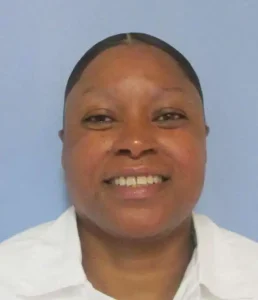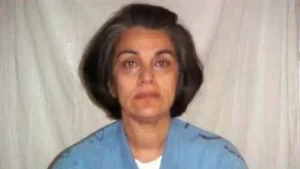
Richard Djerf was sentenced to death by the State of Arizona for a quadruple murder
According to court documents Richard Djerf would force his way into a home and bound Patricia Luna and her 5-year-old son. When Rochelle Luna arrived at the home she was sexually assaulted and murdered. When Albert Luna, Sr arrived at the home he was bound and beat to death with a baseball bat. Richard Djerf would then fatally shoot Patricia Luna and her five year old son
Richard Djerf would be arrested, convicted and sentenced to death
Richard Djerf was executed on October 17 2025
Richard Djerf Photos

Richard Djerf FAQ
Where Is Richard Djerf Now
Richard Djerf is incarcerated at ASPC Florence
Richard Djerf Case
The defendant (Richard Djerf) and Albert Luna, Jr. met and became friends while working as night custodians at a Safeway supermarket. In January 1993, Luna entered defendant’s apartment without defendant’s permission and took several items, including a television, a VCR unit, stereo equipment, a car alarm, and an AK-47 assault rifle. Although defendant told Glendale police he suspected Luna had committed the crime, the police took no action. The matter festered for several months until the defendant, still angered by the burglary and frustrated by police inaction, determined to take revenge.
¶ 3 In the late morning hours of September 14, 1993, defendant (Richard Djerf) went to the Luna family home, taking his nine-millimeter Beretta handgun, a knife, latex gloves, handcuffs, red fuse cord, and artificial flowers in a vase to use as a ruse to gain entry. When Luna’s mother, Patricia, answered the door to receive the flowers, defendant pushed his way into the house, showing her his gun. Defendant took Patricia into the master bedroom and bound her, letting her five-year-old son, Damien, run free. Later, while holding Damien hostage, defendant freed Patricia and forced her to place items of property into the Luna family car, including two VCR units, a telephone, a caller ID box, a stereo CD player, four watches, change, and a money clip with food stamps. He then took Patricia and Damien into the kitchen and bound them to chairs with rope and black electrical tape. More than once, he asked Patricia whether she or her son should die first. He also asked her if she knew the whereabouts of her son, Albert Jr.
¶ 4 Around 3:00 p.m., Rochelle, Patricia’s daughter, age eighteen, came home. Defendant (Richard Djerf) took Rochelle to her bedroom, gagged her with tissue paper and tape, tied her wrists to the bed, cut and removed her clothes with a knife, and raped her. Defendant then stabbed Rochelle four times in the chest and slit her throat, severing the jugular vein. Two of the chest wounds and the throat wound were potentially fatal. Rochelle further suffered multiple shallow knife wounds to the back of her head while she was alive, and one, probably postmortem, superficial stab wound to her right temple. Her earring had been torn through the earlobe. At some point while still alive, Rochelle vomited behind the gag and aspirated the vomit. Defendant then told Patricia he had raped and killed her daughter.
¶ 5 Around 4:00 p.m., Albert Luna, Sr. arrived home from work. Defendant (Richard Djerf) handcuffed him, forced him to crawl to the master bedroom, and placed him face down on the bed. He struck Albert in the back of the head multiple times with an aluminum baseball bat, inflicting three large lacerations and spattering blood throughout the room. The medical examiner testified that hemorrhaging from these wounds was potentially fatal. Defendant removed the handcuffs from Albert, taped his hands and wrists together, and left him for dead. He then walked to the kitchen and told Patricia that he had killed her husband.
¶ 6 Defendant next attempted to snap Damien’s neck by twisting the head abruptly from behind, “like he had seen in the movies.” In fact, he “turned [Damien’s head] all the way around and nothing happened,” so he freed the child’s head. In an attempt to electrocute Damien, defendant cut an electrical cord from a lamp in the kitchen, stripped the insulation from the wires, and taped it to the skin on Damien’s calf. The cord was found unplugged at the scene.
¶ 7 Albert, although badly injured, freed himself from the tape around his wrists, went to the kitchen, and charged defendant with a pocketknife, wounding him seriously. During the ensuing struggle, defendant stabbed Albert with enough force to drive a knife through the right arm and into the torso. Defendant managed to pull the Beretta from his belt and shot Albert six times. Albert fell at the feet of his wife and son.
¶ 8 Defendant asked Patricia, “Do you want to watch your kid die, or do you want your kid to watch you die?” Defendant then shot both Patricia and Damien in the head at close range.
¶ 9 Defendant splashed gasoline on the bodies and throughout the house. His girlfriend, Emily Boswell, testified that defendant told her he lit the red fuse cord but put it out when he realized there were children playing outside and he could not leave the house immediately without being seen. A short while later, he turned on two of the kitchen stove burners, placed an empty pizza box and a rag on the stove, and left the house. Defendant then drove to his apartment in the Lunas’ family car, the stolen property inside, where he encountered Boswell at about 6:00 p.m. He told Boswell that he had been stabbed by two men who tried to rob him. He later went to the hospital and was admitted.
¶ 10 For some reason, the pizza box and rag failed to ignite the gasoline. Albert Jr. had not gone to his home the night of September 13, and did not return until 11:45 p.m. the day of the murders, September 14. Numerous unanswered calls to the house had made him anxious. When Luna entered the home and discovered the bodies of his parents and brother, he immediately left and drove to his girlfriend’s house where he called the police.
¶ 11 The next day, September 15, defendant disclosed to Boswell that he had murdered four members of the Luna family and described to her how he had done it. Defendant told Boswell that the blood dripping from Patricia’s gunshot wound was “really awesome” and “you should have been there.” On September 16, a friend, Travis Webb, checked defendant out of the hospital, but defendant was unwilling to go to his own apartment. Webb rented a motel room, where defendant stayed until September 18. Also on September 16, defendant called another friend, Daniel Greenwood, in California, and once again, revealed his role in the four murders. While in the motel room, defendant also told Webb of his involvement in the murders at the Luna home.
¶ 12 On September 18, Phoenix police executed search warrants on the motel room and defendant’s car and apartment. The police found handcuffs, a nine-millimeter Beretta, a stereo CD player, two VCR units, a U.S. West caller ID unit, artificial flowers and a vase, watches, Rochelle’s charm necklace, a cardboard knife sheath, Patricia’s car keys, a telephone, loose change, food stamps, and a red fuse cord. Police arrested defendant the same day. At the time of arrest, the police found a handcuff key and a newspaper section containing an article about the killings in his possession
https://caselaw.findlaw.com/court/az-supreme-court/1006872.html
Richard Djerf Execution
A man who was convicted of killing four members of a Phoenix family over 30 years ago as an act of revenge was executed Friday, marking Arizona’s second execution of the year.
Richard Kenneth Djerf, 55, died by pentobarbital injection at the Arizona State Prison Complex in Florence.
County Attorney Rachel Mitchell commented on Djerf’s execution in a news release shared by Maricopa County Attorney’s Office on Friday.
“There are some crimes so unspeakable, so devoid of humanity, that justice demands the ultimate punishment,” Mitchell wrote. “This is that case. Richard Djerf is a prime example of why the death penalty exists.”
Mitchell went on to add, “Today was a day of final justice—not only for the memory of the four innocent lives he took, but also for the only surviving son and the extended Luna family, who have carried the weight of that loss every single day.”
Djerf pleaded guilty to murder in the deaths of couple Albert Luna Sr. and Patricia Luna; their daughter Rochelle Luna, 18; and son Damien Luna, 5, at their home on Sept. 14, 1993. Djerf, who has been in prison for over 29 years, chose not to seek clemency.
Djerf’s execution is the fourth in the country this week and the 39th of the year.
Prosecutors said Djerf blamed another family member, Albert Luna Jr., who did not witness the killings, for an earlier theft of electronics from his apartment. Djerf became obsessed with exacting revenge and went to the home months later claiming to be delivering flowers, prosecutors said.
Authorities say Djerf sexually assaulted Rochelle Luna and slashed her throat; beat Albert Luna Sr. with an aluminum baseball bat and stabbed and shot him; and tied Patricia and Damien Luna to kitchen chairs before fatally shooting them.
During Friday’s execution, a team of four people including medical doctors and a phlebotomist prepared syringes of saline and pentobarbital, inserted an IV and injected the chemicals into Djerf.
Arizona has been criticized in the past for taking too long to insert IVs during lethal injection executions. Experts say it should take seven to 10 minutes from the beginning of insertion until a proclamation of death. The state has paused executions twice since 2014 amid concerns over its use of the death penalty.
There was a nearly eight-year hiatus brought on by difficulties in obtaining the needed drugs and criticism that a 2014 execution was botched: Joseph Wood was injected with 15 doses of a two-drug combination over two hours, leading him to snort repeatedly and gasp hundreds of times before he died.
Executions resumed in 2022, and three prisoners were put to death that year. They were paused again in 2023 after Democratic Gov. Katie Hobbs ordered a review of the capital punishment protocol and Democratic Attorney General Kris Mayes agreed not to pursue any. The review ended in November 2024, when Hobbs fired a retired federal magistrate she had appointed to examine execution procedures, and the state corrections department announced changes in the lethal injection team.
Arizona last carried out a death sentence in mid-March, executing Aaron Brian Gunches for the 2002 killing of Ted Price.
There are currently 108 prisoners on the state’s death row.
Arizona executes man who killed 4 members of a Phoenix family in 1993