
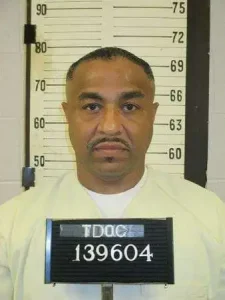
Tony Carruthers is scheduled to be executed by the State of Tennessee for a triple murder that occurred over thirty years ago
According to court documents Tony Carruthers and James Montgomery
would kidnap Delois Anderson, her son Marcellous and friend Frederick Tucker.. The two men would be fatally shot. Delois would be buried alive
Tony Carruthers would be convicted and sentenced to death
Tony Carruthers execution is scheduled to take place on May 21 2026
Supporters are hoping to get his execution halted due to the case being mostly circumstantial evidence and the lack of DNA testing
James Montgomery was initially sentenced to death however his sentence would later be overturned. James brother Jonathan Montgomery would also participate in the triple murder however he would commit suicide before his trial began
UPDATE – Tony Carruthers was granted a one year stay by the Governor as they were unable to find a useable vein
Tony Carruthers Execution News
More than 50,000 people have signed a petition to halt the execution of Tennessee inmate Tony Carruthers, who is on death row for allegedly murdering three people.
Carruthers was convicted for the 1994 first-degree murders of Marcellos Anderson, Delois Anderson and Frederick Tucker. His execution has been scheduled for Thursday, but his case has stirred a national outcry.
Late last month, his attorneys filed a complaint for relief, saying that his conviction was “based entirely on circumstantial evidence, including testimony from a secretly paid informant, several convicted felons, and the medical examiner’s false and discredited testimony.” In announcing that complaint, his attorneys said that they would ask Gov. Bill Lee for clemency.
Last week, Kim Kardashian put out a plea to stop his execution as well, writing on her Instagram story that he would be executed “without testing DNA and fingerprint evidence that could prove his innocence.”
“Call Governor Lee’s office and ask him to test the DNA before it’s too late,” she wrote.
The latest petition will be delivered to Gov. Lee’s office on Monday. Tim Hughes, the president of the NAACP Nashville, and Carruthers’ sister, Tonya Carruthers, will help deliver the petition and speak at a rally after
Tony Carruthers Execution More News
The latest effort to pause Tony Carruthers’ execution was denied by a federal judge in Nashville on May 15.
Carruthers has been on death row since 1996 after being convicted of killing three people and burying them beneath another person’s grave in a Memphis cemetery. After 30 years on death row, he is slated to be executed on May 21.
“The court is aware how much is at stake here — for both sides, but especially for plaintiff,” the order read. “But precisely because the stakes are so high, and because the requested stay is an extraordinary remedy, plaintiff’s claims need to be very sound. And they simply are not when the court cannot even ascertain what the applicable liberty interest is.”
The latest denial to stay Carruthers’ execution came as his attorneys, with the American Civil Liberties Union of Tennessee, have attempted to have fingerprint and DNA evidence tested. The ACLU has said this evidence could exonerate Carruthers, who was convicted with little physical evidence at trial.
The bulk of the evidence prosecutors presented against Carruthers came in the form of witness testimony, many of whom were involved in the drug trade and alleged they were told about Carruthers’ plan.
The lawsuit filed by the ACLU challenges the way Tennessee’s fingerprint law has been applied by the courts, saying it violates due process rights because it has “a near impossible burden.” It also alleges the courts have not allowed meaningful access to postconviction proceedings by their “refusal to allow the fingerprints to be tested, declining to acknowledge potentially exculpatory evidence.”
It also challenges Tennessee’s DNA testing law, saying the courts have not allowed it to be used to vindicate death row inmates who are under time constraints.
U.S. District Court Judge Eli Richardson for the Middle District of Tennessee, in his May 15 ruling, said Carruthers “lacks a significant likelihood of success on each of his claims” on the merits. Those merits, according to Richardson, primarily fall into whether the court has jurisdiction over this case.
Prior case law limits the jurisdiction of federal judges when it comes to reviewing state court rulings, with the exception of general challenges to a law’s constitutionality. In this case, Richardson said, Carruthers’ challenges to the fingerprint law “amount to complaints about an injury caused directly and specifically by prior state-court judgements, names the fingerprint act denials.”
“In summary, claim one and claim two specifically seek effectively to overturn Tennessee state-court decisions that have already occurred — i.e., the fingerprint act denials — and are based on an injury derived from these state-court judgements,” Richardson wrote.
Ultimately, he said, “the court lacks subject-matter jurisdiction to adjudicate (the claims).”
Richardson largely came to the same conclusion for Carruthers’ claims about DNA testing, with the exception of questions about how the DNA testing law will be applied in the future to Carruthers. But Richardson ultimately would find there was an unlikelihood that Carruthers would be successful on the merits of that challenge, too.
The ACLU, almost immediately after the ruling was handed down, appealed to the U.S. Sixth Circuit Court of Appeals.
Tony Carruthers’ execution not halted, ACLU appeals ruling
Tony Carruthers Execution Stopped
Tennessee’s governor granted a one-year stay of execution for Tony Carruthers after his lethal injection was halted Thursday when officials struggled to find a vein for more than an hour.
Maria DeLiberato, an attorney for Carruthers, said she saw him “wincing and groaning” while officials attempted to find a vein, calling it “horrible” to watch.
DeLiberato was addressing reporters when the reprieve was announced and began crying.
“That’s amazing!” she said. “I’m so grateful!”
In a written statement, the Tennessee Department of Corrections said medical personnel had quickly established a primary IV line but were unable to find a suitable vein for a backup line as required by the state’s execution protocol. Efforts to insert a central line also failed, and officials called off the execution.
Carruthers’ lawyers asked a federal court and the Tennessee Supreme Court on Thursday to put his execution on hold, saying continuous attempts to access a vein constitute “cruel and unusual punishment.”
States have repeatedly had to call off executions because of such challenges. In Idaho in 2024, medical team members tried eight times to establish an IV line to execute Thomas Creech, one of the nation’s longest-serving death row inmates, before calling it off; Idaho Gov. Brad Little subsequently signed a law making firing squad the state’s primary method of execution.
In Alabama, Gov. Kay Ivey paused executions for several months after officials called off the lethal injection of Kenneth Eugene Smith in 2022 — the third time since 2018 Alabama had been unable to conduct executions due to problems with IV lines.
Carruthers, 57, was sentenced to death after being found guilty of the 1994 kidnappings and murders of Marcellos Anderson; his mother, Delois Anderson; and Frederick Tucker. He was forced to represent himself at trial after repeatedly complaining about court-appointed attorneys and threatening to harm several of them.
There was no physical evidence tying Carruthers to the killings, and he was convicted primarily on the basis of testimony from people who claimed to have heard him confess to or discuss the crimes.
They include a man who was later revealed to be a police informant and told media he was paid for his testimony. A co-defendant, James Montgomery, was originally sentenced to death along with Carruthers but was later resentenced and released from prison in 2015, according to court filings.
Authorities said Marcellos Anderson was a drug dealer, and Carruthers was trying to take over the illegal drug trade in their Memphis neighborhood. Carruthers’ attorneys have said their client’s “paranoia and delusions” prevented him from being able to cooperate with court-appointed counsel, but the judge viewed this behavior as willful.
The Tennessee Supreme Court said on appeal that Carruthers’ actions before the trial jury were offensive and self-destructive but the situation in which he found himself was one of his own making.
Carruthers’ attorneys have tried to show that he is incompetent to be executed. They claim in court filings that Carruthers believes the government is bluffing about executing him in order to coerce him into accepting a plea deal that exists only in his mind. That way, Carruthers believes, the government can avoid paying him what he thinks are millions of dollars it owes him. He is convinced that his own attorneys are part of a conspiracy against him and refuses to even speak with them, according to court filings.
The number of executions in the U.S. surged from 25 in 2024 to 47 last year, driven by a sharp increase in Florida. That state carried out 19 executions in 2025, up from one the previous year, according to the Death Penalty Information Center. So far this year, four states have executed 13 people, and 11 other executions are scheduled including one Thursday evening in Florida.
It’s not unusual to see several executions over a short period of time. Last year, four people were executed over three days in March in Oklahoma, Florida, Louisiana and Arizona. Another five people were executed over a week in October in Arizona, Mississippi, Missouri, Florida and Indiana, according to the Death Penalty Information Center.
Tennessee began a new round of executions last year after a three-year pause following the discovery that the state was not properly testing lethal injection drugs for purity and potency.
An independent review later found that none of the drugs prepared for the seven inmates executed in Tennessee since 2018 had been fully tested. The state attorney general’s office also conceded in court that two of the people most responsible for overseeing Tennessee’s lethal injection drugs “ incorrectly testified ” under oath that officials were testing the chemicals as required.
Tennessee halts man’s execution after being unable to find vein for lethal injection, attorney says